Thursday, March 3, 2011

Wednesday, March 2, 2011

Read Across America Day

Happy Birthday, Dr. Seuss.  The fun in your books spilled over into Read Across America Day.  At the library we provided Dr. Seuss book marks for kids to color; a Seuss is Loose story time; and a Dr. Seuss book display.  I wore my Dr. Seuss shirt, saved all year for this day, and my red-and-white stripped stove pipe hat.  Lorton Patch published my Read Across America Day guide for parents, reprinted below.  It was a good day.

A Parent's Guide to Read Across America Day

Grab a book! March 2 is Read Across America Day.

The National Education Association’s Read Across America Day is a reading motivation and awareness program “that calls for every child in every community to celebrate reading on March 2, the birthday of beloved children’s author Dr. Seuss.”

Adults are encouraged to read aloud to a child on Read Across America Day. For that purpose, here are four books recommended by school librarians as great read-alouds.

Green Eggs and Ham is one of 46 children’s books written by Dr. Seuss. “Do you like green eggs and ham,” asks Sam-I-am? The patter and pacing of the rhyme help children recall the story and anticipate the words. This generates participatory reading. Best of all, when the unnamed character finally tries green eggs and ham, he likes them! The next time a child tells you they don’t like something -- you can remind them of green eggs and ham.

Rattletrap Car by Phyllis Root, illustrated by Jill Barton, is another participatory read. On a hot June day, Jake, Junie, Poppa and the baby head to lake. Getting there is quite an adventure. If the reader prepares ahead of time, the sounds of Poppa turning the key to start the car will repeat at each juncture, and listeners can be encouraged to add the last “pop!”

Poetry is a great read aloud for children, especially when introduced in small doses. Small Talk: A Book of Short Poems selected by Lee Bennett Hopkins provides just that. Thirty-three short, simple poems picture common events in a child’s life. For example, Aileen Fisher provides “Growing Up”:

"When I grow up
(as everyone does)
what will become
of the Me I was?”

Even older children enjoy hearing stories. The unexpected and frightening events in Jumanji by Chris Van Allsburg captivate kids. And just when they think they have it figured out, Daniel and Walter Budwing set out with a long, thin box. Yes, the book is better than the movie!

These are just four of hundreds of books your local librarian can recommend for you to read to your children on Read Across America Day or any day.

You'll also find suggestions in a new book by the editors of Horn Book Magazine, a premier guide to literature for children and young adults. A Family of Readers: The Book Lovers Guide to Children’s and Young Adult Literature by Roger Sutton and Martha V. Parravano, provides essays and book recommendations from a variety of authors and editors.

A Family of Readers is divided into four sections: Reading to Them; Reading With Them; Reading on Their Own; and Leaving Them Alone. It covers everything from picture books to teen fiction, poetry to graphic novels, all in an engaging, conversational tone.

According to the NEA, “Motivating children to read is an important factor in student achievement and creating lifelong successful readers.” Read Across America Day is a perfect opportunity to model and motivate reading. For more information and resources, visit NEA’s Read Across America Day and Seussville, the official Dr. Seuss site.

Saturday, February 26, 2011

Of Thee I Sing

My first thought when I saw it in the bookstore was, "I wonder if it's any good, or if it's published just because of the author?"  Of Thee I Sing: A Letter to My Daughters is by President Barack Obama. I'm curious if the idea originated with him.

In this picture book, Obama tells his girls how wonderful they are, and he compares their qualities to people in history who have demonstrated that character.

On the left side of each two page spread, Malia and Sasha stand with their backs to the reader and are joined by other children as the book progresses. The right side of the two page spread features a large picture of a famous person with a short verse about them underneath. The book is interesting for the biographic sketches it provides of 13 "Americans." I like the additional information about these famous people on the book's last page.

Loren Long is the book's illustrator. His picture of Sitting Bull has caused a stir, discussed on the blog American Indians in Children's Literature. In her post, Debbie Reese quotes from an email she received from Horn Book Editor Roger Sutton.

"Loren Long chose to depict Sitting Bull as a sort of landscape, with buffalo for eyes, hills and cracked earth for nose and mouth, and some pine trees placed so they form eyebrows (and, dare I say, boogers). It's the old one-with-nature stereotype, which wouldn't be so bad had all of the other subjects of the book not been depicted realistically."

In a later post, Debbie Reese shares what Sitting Bull's great grandson Eric LaPointe thinks of the book. He said,"I told her [a reporter] my great grandfather was never American. He was Lakota." Of Thee I Sing labels Sitting Bull a Sioux and an American.

LaPointe also said that he does not appreciate his great grandfather being included in a book which honors George Washington and Abraham Lincoln, because of what they did to native peoples. He gives details.

Even the quote attributed to Sitting Bull is problematic. It reads, "For peace, it is not necessary for eagles to be crows."

As Reese points out, "that line did not start with 'For peace'." She gives the full quote from Vine Deloria Jr.'s God Is Red (p. 198). "Deloria writes that this was Sitting Bull's reply to a question about why he did not surrender and return to the U.S. to live on a reservation:

'Because I am a red man. If the Great Spirit had desired me to be a white man he would have made me so in the first place. He put in your heart certain wishes and plans, in my heart he put other and different desires. Each man is god in his sight. It is not necessary for eagles to be crows.'"

While Fox News blasted Obama for including Sitting Bull in the book, they failed to check their facts. The first headline Fox Nation posted about the book read, "'Obama Praises Indian Chief Who Killed Custer." It was soon thereafter changed to "defeated." Sitting Bull, however, was not at the Battle of Little Big Horn.

There's been a lot of discussion around this one picture book. And while including a Native American was positive, it should have been done with respectful accuracy. Because of its inaccuracies, it should be pulled from all library shelves.

Friday, February 18, 2011

Abraham Lincoln

Abraham Lincoln is recorded as saying, “The things I want to know are in books; my best friend is the man who’ll give me a book I ain’t read.” On February 12, 2011, the United States celebrated the 202th anniversary of the birth of our 16th president. Here are nine books for children and teens which honor this great man.

Lincoln and His Boys by Rosemary Wells, illustrated by P. J. Lynch.
Recommended for ages 9 to 12.
Author Rosemary Wells bases this historical-fiction biography on a discovery she made while researching another Civil War era book: a 200 word fragment written by Willie Lincoln about a trip taken with his father Abraham Lincoln. In Lincoln and His Boys, Will and Tad take turns describing family life in the Lincoln household. The book is beautifully illustrated with oil paintings completed after careful study of hundreds of Lincoln images.

Abraham Lincoln Comes Home by Robert Burleigh, illustrated by Wendell Minor.
Recommended for ages 4 to 8.
Following Abraham Lincoln’s assassination, Americans turned out by the thousands to honor the Civil War president as his funeral train traveled thirteen days from Washington, D.C., to his burial in Springfield, Illinois. Burleigh’s prose and Minor’s paintings record the fictionalized experience of a young boy as he shares in the Nation’s grieving.

Lincoln Shot: A President’s Life Remembered by Barry Denenberg, illustrated by Christopher Bing.
Recommended for ages 9 to 12.
The author writes in the style of newspapers of the time and includes factual information and copies of actual photographs with a chronology of Lincoln’s life, an index, and a list of picture credits at the end of the book. (Note: A problem with this book is that the author and illustrator do not provide article credits, footnotes or a bibliography. Readers are left to wonder which writings and illustrations in the book are actual reprints, and which are their own creation.)

The Lincolns: A Scrapbook Look at Abraham and Mary by Candace Fleming. Recommended for ages 10 to 14.
An in-depth and personal glimpse into the lives of Abraham Lincoln and Mary Todd Lincoln, this book includes photographs, copies of documents, and highlights about the people important in Lincoln’s life and times. The author spent five years researching, and it is evident in the quality and thoroughness of the finished work. Unique to this book is the new insight into Mary Lincoln’s life provided by recently recovered personal letters.

Abe Lincoln Crosses a Creek: A Tall, Thin Tale (Introducing His Forgotten Frontier Friend) by Deborah Hopkinson, illustrated by John Hendrix. Recommended for ages 4 to 8.
Young Lincoln, age seven, and his ten-year-old friend Austin get themselves into big trouble down at Knob Creek in this historical fiction picture book.

Abe’s Honest Words: The Life of Abraham Lincoln by Doreen Rappaport, illustrated by Kadir Nelson.
Recommended for ages 4 to 8.
Each two-page spread of this picture book style biography features author Rapport’s brief stanza highlighting a portion of Lincoln’s life, a related quote from Lincoln, and a painting by the illustrator. The last four pages of the book include a list of important dates in Lincoln’s life, suggested resources, and the full text of the Gettysburg Address. Unfortunately, there is no documentation in the book from when and where Lincoln’s quotes are taken.

Lincoln Through the Lens: How Photography Revealed and Shaped an Extraordinary Life by Martin W. Sandler.
Recommended for ages 9 to 12.
History professor and award-winning writer Martin Sandler documents more than 100 photographs of Abraham Lincoln’s life and times. Included in this collection is the only known pre-Gettysburg Address photograph of the sixteenth President.

Two Miserable Presidents: Everything Your Schoolbooks Didn’t Tell You About the Civil War by Steve Sheinkin, illustrated by Tim Robinson. Recommended for ages 9 to 12.
Sheinkin is a former textbook writer who confesses to how boring they can be. In Two Miserable Presidents he uses real-life accounts and actual quotes – the stuff he was not allowed to use in textbooks. What results is an attention-grabbing and readable account of the Civil War, with focus on Presidents James Buchanan and Abraham Lincoln. Sheinkin ends the book with a review of what happened to the key players after the war, interesting source notes, resources for further study, and an exhaustive index. Every quotation in the book is repeated in a chapter-by-chapter list providing the source.

Stand Tall, Abe Lincoln by Judith St. George, illustrated by Matt Faulkner.
Recommended for ages 4 to 8.
This engaging picture book biography spotlights Abraham Lincoln’s childhood from birth in Kentucky to his early teen years in Indiana. The book underscores Lincoln’s perseverance through poverty and hardship, including the death of his mother when he was only nine. Prominence is given to Lincoln’s step-mother, Sally Johnston, and her support of his mostly self-education. Herself illiterate, Sally loaned Lincoln books and advocated for his attending school whenever one was available. With Sally’s love, Lincoln “gained confidence to take his sense of fairness, his careful way of thinking, his hatred of cruelty and his ability to settle quarrels out into the world.” Author St. George points out the life experiences that formed the character of the man who became the 16th President of the United States.

Wednesday, February 16, 2011

A Long Walk to Water

Nya walks eight hours every day to bring water to her family. The trip to the watering hole isn't as bad as the trip back to the village, when the water weights the jugs.

Salva is in school when the shooting and bombing explode. His teacher tells the students to run. Salva's running turns to days and weeks and months of walking. He becomes one of the Lost Boys, walking to escape war.

Linda Sue Park weaves together the lives of Nya and Salva in her book A Long Walk to Water. Linda met Salva through his nonprofit organization, Water for Sudan. Her book is based on his life story.

A Long Walk to Water is an exceptional book for kids to read because it presents life in another culture. The story is at times frightening, but not overly done for young readers. They will be introduced to the country of Sudan, the reality of civil war and refugee camps, and the current day needs of people in other places. Through the characters of Nya and Salva, they will view perseverance and service for others. Perhaps, too, they will gain an appreciation for the water so abundantly available to Westerners through taps in our homes and schools.

A Long Walk to Water was published in 2010 by Clarion Books.  It is recommended for kids in grades 5 - 8, but also is appropriate for 4th graders who are advanced readers.

Saturday, February 12, 2011

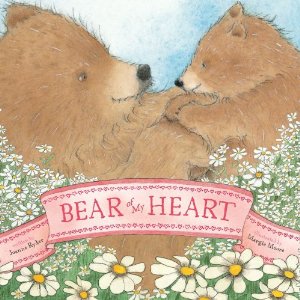
Bear of My Heart

This is not a Valentine's Book, per se, but it fits the holiday beautifully.  Written by Joanne Ryder and illustrated by Margie Moore, it's a poetry picture book recommended for ages 3 - 6.  It works well for reading aloud to a story time group.

"There are so many bears in the world, dear, but there's no other one that will do.  You are the bear of my heart, dear, and I am the one who loves you.

"I have so many stories to tell you.  I know wonderful places to see. And because we can see them together, they'll be nicer for you and for me.

"Let's race in the sun and be happy. Let's splash in the stream and drip dry. Let's roll down a hill and be silly. Let's lie and watch clouds drifting by.

"Let's sit nose to nose and share secrets. Let's wish on a star, eyes shut tight. Let's whisper our dreams in the darkness. Let's snuggle together at night.

"If you need me, I'll be there beside you.  If you're lonely, I'll hug you awhile. If you're lost, I will be there to guide you.  If you're sad, I won't quit till you smile.

"Paw in paw, we will greet every morning.  Paw in paw, we will meet every day. You are the bear of my heart, dear, and nothing can take that away.

"No matter how big you may grow, dear, or whether we're near or apart, I will love you forever and ever, for YOU are the bear of my heart."

Friday, February 11, 2011

Me, Frida

Superbly written, beautifully illustrated, and well crafted, this book about an artist is itself a work of art.  Me, Frida, written by Amy Novesky and illustrated by David Diaz, tells the true story of how Frida Kahlo came to create Frieda and Diego Rivera, the first painting she produced in what became her famous folkloric style. 

In November 1930, Frida accompanied her famous husband Diego Rivera from their home in Mexico to San Francisco. It was Frida's first trip outside her homeland.  While Diego painted murals for the city, Frida explored.  But living in a foreign country where she didn't know the language and had very few friends was difficult.  Diego was busy.  Frida felt lost.

As time passed, Frida discovered China Town, traveled across the Golden Gate Bridge, and was inspired to paint.  She painted a portrait of Diego and herself, adorning it with a pink bird and a violet ribbon on which she wrote, "Here you see us, me, Frida Kahlo, with my adored husband Diego Rivera.  I painted these portraits in the beautiful city of San Francisco, California ... in April of 1931."  Today that oil on canvas hangs in the San Francisco Museum of Modern Art.

Wednesday, February 9, 2011

Kindness for Valentine's Day

Valentine's Day is getting a bad wrap these days. Joe Dellosa's opinion sums up what I've been hearing:
"... Valentine's Day [has] become a crassly artificial holiday that seeks to commodify our emotions and homogenize the way we express our love as a means to boost corporate profits, while fomenting awkward, hurtful feelings among couples and mopey misery among singles."  That's one way to look at it.

I like Valentine's Day because it's an opportunity to have some fun thinking of others. The tiniest remembrance -- a card, an email, a piece of candy, a single flower -- can brighten someones day.

The children's picture book Love and Kisses by Sarah Wilson, illustrated by Melissa Sweet, reminds me of the good that results from an act of kindness. When a little girl shares a kiss, it travels from friend to friend and eventually, surprisingly, comes back to her.

The Alexandria (MN) Kiwanis and Golden K Clubs are sponsoring their annual Random Act of Kindness Week, February 13 - 19, in an effort to bring awareness to the power of kindness.  Alexandria Kiwanis Club President Diann Drew says, "A simple gesture, a kind word, or a random act of kindness can go a long way in making a community a stronger, better place."

Sunday, February 6, 2011

The Paper Crane

A man owned a restaurant on a busy road, and business was good until a new highway was built close by. Because travelers no longer stopped at the restaurant, the man became poor. One day a stranger with a gentle manner came into the restaurant. He did not have money to pay for his meal. Instead, he folded a napkin into the shape of a crane. "You have only to clap your hands," he said, "and this bird will come to life and dance for you." The stranger's gift was worth more than the cost of his meal, and it brought great happiness to the restaurant owner. Can you guess why?

The Paper Crane is Molly Bang's adaptation of an ancient Japanese folktale. The detailed three-dimensional illustrations are photographs of her paper cutouts. They are a wonderful accompaniment to the story.

Friday, February 4, 2011

A Pair of Red Clogs

Mako, a little Japanese girl, is delighted with her new clogs. They are red lacquered and shine beautifully. When Mako walks and runs, her clogs sing: KORO KORO, KARA KARA. Mako chose these when her mother took her shopping. They are her school shoes.

But one day as Mako is playing the weather-telling game with her friends, one of her shiny new clogs cracks. No longer do her clogs sing when she walks. Mako is sad. So sad that she devises a plan that in the end just makes her sadder.

When Mako grows up and buys a pair of red clogs for her granddaughter, she remembers her own red clogs, and the important lesson she learned from them.

A Pair of Red Clogs by Masako Matsuno, illustrated by Kazue Mizumura, is a book that links well to Lunar New Year themes and Asian-Pacific American Heritage Month in May. The lesson learned by a little Japanese girl is one that children of all cultures will understand.

Thursday, February 3, 2011

New Clothes for New Year's Day

Happy [Lunar] New Year! Today is the first day of the Year of the Rabbit. Hyun-Joo Bae has written and illustrated a lovely picture book called New Clothes for New Year's Day. "It's a new year, it's a new day, and it's a new morning. It's the first day for the beginning of everything," says a young Korean girl. She is excited to dress in her new clothes for making New Year's calls.

My favorite parts of this picture book are the beautiful illustrations and the end pages providing details about Lunar New Year traditions.

This translated edition was published in 2007 by Kane/Miller Book Publishers, Inc.

"I wish you good luck."

Wednesday, February 2, 2011

Spring Is Coming No Matter What the Groundhog Does

Folklore has it that winter will continue for six more weeks if a groundhog sees his shadow on February 2. To me, that has always seemed counterintuitive. If the sun is out to cast a shadow, shouldn't that mean warmer weather is near? But the tradition means that the groundhog is frightened by his shadow and retreats into his den to hibernate another six weeks.

Groundhog Day originated in Europe centuries ago, and is based on the ancient belief that the emergence of a hibernating creature forecast the imminent arrival of spring. When Germans settled in Pennsylvania in the 18th century, they brought the custom with them. In Europe different animals were used, including badgers and bears. Groundhogs were plentiful in Pennsylvania, so that’s the animal that got the job there.

The History Society of Berks County in Reading, Pennsylvania, has the earliest known record of Groundhog Day in the United States. A February 5, 1841, diary entry by Berks County, Pennsylvania, storekeeper James Morris reads:

“Last Tuesday, the 2nd, was Candlemas day, the day on which, according to the Germans, the Groundhog peeps out of his winter quarters and if he sees his shadow he pops back for another six weeks nap, but if the day be cloudy he remains out, as the weather is to be moderate.”

Candlemas is a traditional name for the Catholic Feast of the Presentation of Jesus at the Temple. It is mentioned in this English poem:
As the light grows longer
The cold grows stronger
If Candlemas be fair and bright
Winter will have another flight
If Candlemas be cloud and rain
Winter will be gone and not come again
A farmer should on Candlemas day
Have half his corn and half his hay
On Candlemas day if thorns hang a drop
You can be sure of a good pea crop.

Other feasts and festivals also occur on or about February 2, including St Brigid’s Day and Imbolc. February 2 is one of the four cross-quarters of the year. A cross-quarter is a day approximately halfway between a solstice and an equinox.

Some in the past may have marked the beginning of spring when daylight made progress against night, on February 2, the cross-quarter. Others, as we do in modern times, marked spring on the Vernal Equinox, when on March 20 or 21 the sun shines on the equator, making day and night of nearly equal length worldwide. Groundhog Day may have originated as a compromise between the two beliefs.

Groundhog Day has long been popular in the United States, but the 1993 movie of the same name, filmed in Punxsutawney and featuring Phil, established it as an international phenomenon. Press reports estimate the biggest crowd to attend Groundhog Day in Punxsutawney was 40,000. On the morning of February 2, Punxsutawney Phil is pulled from his den by keepers dressed in tuxedos. It has become a raucous event.

Read These!

The Secret of the First One Up by Iris Hiskey Arno, illustrated by Renee Graef

Groundhog Weather School by Joan Holub, illustrated by Kristin Sorra

Groundhog Day by Margaret McNamara, illustrated by Mike Gordon

The Groundhog Day Book of Facts and Fun by Wendie Old, illustrated by Paige Billin-Frye

Monday, January 31, 2011

Dragon Dancing

The Chinese or Lunar New Year is one of the most important annual celebrations in Asian countries and communities. It was first recognized in 2600 BC, when Emperor Huang Ti introduced the Chinese zodiac. Whereas the calendar that begins with January and ends with December is solar -- based on the Earth’s rotation around the sun -- the Chinese calendar is lunar, based on the rotation of the moon around the Earth. Thus the Chinese or Lunar New Year falls on a different day each year, sometime between late January and mid February. It begins on the first new moon of the year and lasts until the full moon 15 days later. (A new moon is not visible from the earth.)

Dragon Dancing by Carole Lexa Schaefer, illustrated by Pierr Morgan, is a good picture book to read for the Chinese New Year. At school, the children listen to a story about dragons, and then make a dragon in art class. The colorful illustrations of the children dragon dancing are beautiful.

Thursday, January 27, 2011

Sleep, Black Bear, Sleep


Jane Yolen and Heidi E. Y. Stemple have created a lovely rhyming lullaby in their 2007 picture book Sleep, Black Bear, Sleep. The book begins:

"Sleep, little one, sleep.
Your dreams are long and deep.
Sleep in your burrow, cave, or den,
Sleep till the winter's done and then
Rise up and start all over again.
Sleep, little one, sleep.
"

Each subsequent two-page spread features a stanza for one of 12 hibernating animals -- black bear, frog, bat, snakes, box turtle, gopher, skunk, badger, beaver, mouse, toad and chipmunk. Brooke Dyer's accompanying illustrations detail each animal and their home.

At the end a child tucked in with stuffed animals hears:

"And even YOU, it's time for sleep,
So snuggle down and burrow deep.
The sheet and quilt will keep you warm
Through winter or through summer storm
Till you awaken in the morn.
Sleep, my little child, sleep
."

Sunday, January 23, 2011

Where Writers Write

This morning at Bruegger's Bagel Bakery in Wellesley, MA, the man at the next table was reading the Boston Globe. The page facing me read, "Where writers write." I am a writer. I bought the paper.

The first few lines of Meredith Goldstein's article could have been taken from my mouth. "I am finishing my first book," wrote Meredith.

Okay, stop here for a comment. If these were my words, they would say, "I am starting my first book." Continue.

"I am finishing my first book. That is, I am finishing my first book when I am not doing laundry, watching marathons of 'House,' or reorganizing my closet."

As a writer, I, too, want to be more productive. Daily life and the responsibilities of being a single Mom working full-time outside of the home compete with my book. Then there are those lazy hours watching Law and Order marathons.

Like Meredith Goldstein, I dream of renting an isolated cabin to escape distractions and write. Last year I snow shoed to the Vermont cabin where Robert Frost wrote during the last years of his life. "It would be nice," I thought.

Also like Meredith, but for slightly different reasons, I will finish my book in my apartment. It's nice to dream. But in the end, it is best to write.

Friday, January 21, 2011

U.K. Plans February 5 Read-Ins to Support Libraries

The blog Voices for Libraries explains what read-ins are and why they are important. Can we apply this in the United States? The Guardian reported in December on these days planned in protest of library budget cuts.

Sunday, January 16, 2011

Linda Asks - Picture Books for Two-Year-Olds

My friend Linda asked for picture book suggestions for a two-year-old. Boy or girl? What are their interests? In the meantime, what are some of your favorite picture books appropriate for preschoolers? I'll start the list with these five:

The Little House by Virginia Lee Burton

Make Way for Ducklings by Robert McCloskey

Emily's House by Niko Scharer

Only One Woof by James Herriot (His Treasury for Children contains this and seven other stories, all superb.)

Library Lion by Michelle Knudsen

I could list lots more, but it's your turn. Please add your favorite(s)!

Saturday, January 15, 2011

Amos McGee Illustrator Wins Caldecott

Last Sunday I recommended the book A Sick Day for Amos McGee. I consider it one of the best picture books of 2010, and I've often recommended it since its publication.

On Monday the book's illustrator, Erin E. Stead, won the Caldecott Medal. Although I don't rely on award and best seller lists, because I often disagree with them, I felt validated by the Caldecott committee's choice. As my librarian friend Nancy said, "Susan called this one!"

Erin E. Stead is only 28-years-old, and A Sick Day for Amos McGee is the first book she's illustrated. Her husband is the book's author. This in itself is a nice story. Erin shared it with the Wall Street Journal.

The Randolph Caldecott Medal is awarded annually by the American Library Association to the artist of "the most distinguished American picture book for children."

A Sick Day for Amos McGee is a book that both children and adults will enjoy. It has now earned both the Caldecott Medal and the LitLinx Seal of Approval.

Sunday, January 9, 2011

A Sick Day for Amos McGee

Zoo keeper Amos McGee takes time each day to visit his good friends. He and the elephant play chess. The tortoise always wins their races. The shy penguin appreciates McGee's quiet company, and the rhinoceros borrows McGee's handkerchief. And the owl, who is afraid of the dark, listens as McGee reads him a story.

When McGee stays home because he's sick, his friends wonder where he is, and set out to find him.

Philip C. Stead has written a lovely story of dedicated friendship. The illustrations by his wife, Erin E. Stead, bring each character to life and provide wonderful details that add to the pleasure of looking at the pictures.

A Sick Day for Amos McGee stands out from many of the picture books published in 2010. Both Steads, writer and illustrator, have invested thought and detail to craft an excellent book.

Thursday, January 6, 2011

A Small Brown Dog with a Wet Pink Nose

Amelia is ready for a dog, but her parents are not. To prepare her parents, Amelia brings home Bones. Bones is small and brown, and has a wet pink nose; and he can only be seen by Amelia. He becomes a real part of the family, so that when he goes missing, a hunt ensues. A clever story with cute illustrations, A Small Brown Dog with a Wet Pink Nose, turns out to be "Amelia's Guide to Getting Your First Dog." Stephanie Stuve-Bodeen is the author, and Linzie Hunter is the illustrator.

Wednesday, January 5, 2011

Picture Book Disappointment

In preparation for a monthly column about picture books, I've been reading 2010 titles owned by my local public library. I'm disappointed by the lack of originality and ingenuity, and shocked that publishers have churned out so much mediocrity.

Tomorrow I'll share two titles with some merit. Today, here are the books that disappointed.

Henry in Love by Peter McCarty (dull)
Subway by Christopher Niemann (ugly)
Children Make Terrible Pets by Peter Brown (doesn't work)
Busing Brewster by Richard Michelson (wrong audience)
Big Red Lollipop by Rukhsana Kahn (weak)
Little Wolf's Song by Britta Teckentrup (nothing new)
My Mommy Hung the Moon by Jamie Lee Curtis (huh?)
What's the Matter, Bunny Blue? by Nicola Smee (stretches to keep rhyme)
Hip Hop Dog by Chris Raschka (inconsistent)
Cinco de Mouse-O by Judy Cox (poor transitions)

Sunday, January 2, 2011

Books Read in 2010

For the third consecutive year, I've kept a list of books read. I count listening to a book as reading, and such titles are included on my list with a (CD) designation.

My least favorite for 2010 is The Last Time I Saw Paris by Elizabeth Adler, for what reason I no longer remember. I know it is my least favorite because my list includes a minus sign after the title.

My favorite is George Washington's Great Gamble: And the Sea Battle That Won the American Revolution by James Nelson. Nelson's research and writing make history come alive. I learned details I never before knew.

My complete list follows. What was your favorite read in 2010?

Books Read in 2010
A Desirable Residence by Madeleine Wickham
A Season of Gifts by Richard Peck
At Risk (CD) by Patricia Cornwell
Bunnicula by Deborah and James Howe
Can You Keep a Secret? (CD) by Sophie Kinsella
Detour Berlin by Ruth Baja Williams
Each Little Bird That Sings by Deborah Wiles
Emma by Jane Austen
Every Day in Tuscany by Frances Mayes
Four to Score (CD) by Janet Evanovich
George Washington's Great Gamble: And the Sea Battle That Won the American Revolution by James Nelson
High Five (CD) by Janet Evanovich
Hornet's Nest (CD) by Patricia Cornwell
Hot Six (CD) by Janet Evanovich
I'll Never Be French by Mark Greenside
Lawn Boy by Gary Paulsen
Olive Kitteridge by Elizabeth Strout
One for the Money (CD) by Janet Evanovich
Plain Truth (CD) by Jodi Picoult
The Birth of Virginia's Aristocracy by James C. Thompson II
The Body in the Library (CD) by Agatha Christie
The Corrections by Jonathan Franzen
The Last Time I Saw Paris (-) by Elizabeth Adler
The Leap by Rick Smith
The Lightning Thief (CD) by Rick Riordan
The Phantom Tollbooth (CD) by Norton Juster
The Scarpetta Factor (CD) by Patricia Cornwell
Three to Get Deadly (CD) by Janet Evanovich
Two for the Dough (CD) by Janet Evanovich
Wandering Souls by S. Scott Rohrer
When You Reach Me (CD) by Rebecca Stead

Saturday, January 1, 2011

Mark Greenside's "I'll Never Be French"

Knowing that I love everything French, a friend gave me a paperback copy of Mark Greenside's I'll Never Be French, published in 2008 by Free Press.  It is an easy read, mostly enjoyable.  It's Greenside's account of purchasing a home in Brittany.

The first two sentences of the book hooked me.  "It begins with a girl.  It always begins with a girl, and even though we don't make it through the summer -- through half the summer  -- she gets me there and changes my life."

I'm a sucker for these kind of memoirs, because I harbor a wish to live them.  Greenside introduces me to a part of France I know little about, and his descriptions of the quality of life enjoyed by the French ring true.

Greenside first goes to France knowing no French, and seems to progress very little with the language as he lives there.  This, and his refusal to dress neatly, seem to be the main reasons he will never be French.  It's his own choosing.

To illustrate his language deficiencies, Greenside records his attempts at conversations in French.  I don't understand why.  His faux-pas (French for "false step") with the language are lost on readers, like me, who speak no French.  These frequent passages become sections to skip.

The book ends abruptly.  The break between the story and the last two paragraphs reminds me of a bad finish to a term paper. 

Mark Greenside will never be French by his own choosing, but the stories of his part-time life in Brittany are interesting.  His book is not a literary great, but it is a quick, mostly fun, read for those who dream of living in Europe.

Sunday, November 28, 2010

A Thanksgiving Thanks Owed to Sarah Hale

Portrait of Sarah Hale
America's Thanksgiving holiday is credited to the Pilgrims. The truth is, we have a national celebration thanks to Sarah Hale's 38-year letter writing campaign.

Sarah Josepha Hale was born in Newport, New Hampshire, in 1788.  Her father, disabled Revolutionary War Captain Gordon Buell, and her mother, Martha Whittlesay Buell, believed in equal education for both sexes. Hale was educated at home by her mother, and by her brother Horatio, who taught her what he'd learned at Dartmouth. Hale continued her education as an autodidact.

According to Laurie Halse Anderson in her book Thank You Sarah: The Woman Who Saved Thanksgiving, Hale grew up listening to her father's Revolutionary War stories.  They made a deep impression on Hale, setting the stage for her commitment to the American Union.

In 1811, Hale's father opened The Rising Sun tavern in Newport.  At that time, Hale was working as a schoolteacher. She met her eventual husband David, a lawyer, and they were married in her father's tavern on October 23, 1813.

The Hales had five children between 1815 and 1822. David died in 1822, and Hale wore black the rest of her life to mourn his death.

Hale began to write to support her young family, publishing her first book of poems, The Genius of Oblivion, in 1823.  Her novel Northwood: Life North and South, subtitled A New England Tale in London, made her one of the first Americans to write in opposition of slavery. The novel was praised by Reverend John Blake, who asked Hale to move to Boston and serve as editor of his journal Ladies Magazine. Hale accepted and served as "editress," her preferred title, from 1828 until 1836.  Her goal was to help educate women.  In the book Boston Women's Heritage Trail Hale wrote that a woman's, "first right is to education in its widest sense, to such education as will give her the full development of all her personal, mental and moral qualities."

In 1830 Hale published Poems for Children, a collection that included the now famous "Mary Had A Little Lamb," which was originally titled "Mary's Lamb." The poem is based on an event that occurred while Hale was working as a school teacher.

Louis Antoine Godey bought Ladies Magazine and merged it with Godey's Lady's Book in 1837.  He brought Hale on as editor, a position she held for 40 years. According to Ann Douglas in her book The Feminization of American Culture, "During this time she [Hale] became one of the most important and influential arbiters of American taste."

Hale's advocacies included education, especially higher education for women, employment for women, the American Union, and the preservation of Mt. Vernon, George Washington's home. She helped found Vassar College, and she raised money for the completion of the Bunker Hill Monument in Boston.

 Sarah Hale Exhibit at Bunker Hill Museum
Hale also wanted Thanksgiving to be a national holiday, and she started a campaign to bring it to pass in 1825. In Hale's day—two hundred years after the pilgrim's arrival—Thanksgiving had been mostly forgotten.

But, Hale used her editorial position to garner support for a Thanksgiving Day.  Individual states began to declare their own Thanksgiving holidays.  But Hale remembered her father's stories, and she had a bigger goal. She wanted the entire country to celebrate Thanksgiving together, on the same day. She continued her articles and letter writing campaigns. Then she went to the top.  She wrote to the President of the United States.  But Zachary Taylor said, "No." 

So Hale wrote to the next president, Millard Fillmore. He also said, "No."  Hale continued her state-by-state campaign until a new president came to office. She wrote to President Franklin Pierce.  She received another no.  Then it was President James Buchanan.  No.

By now America was at war, North against South. Some states that had instituted a day of Thanksgiving were no longer holding the celebration.  Hale had been working on this project for more than 35 years, and it looked more hopeless than ever.  According to the Hale's biographer Anderson, "She [Hale] picked up her mighty pen and wrote another letter; this time to President Abraham Lincoln.  America needed Thanksgiving, now more than ever, Hale argued. "A holiday wouldn't stop the war, but it could help bring the country together." Abraham Lincoln agreed.

In 1863, Lincoln made Thanksgiving a national holiday. And it has been a national holiday in November ever since.

The Thanksgiving we celebrate today is based on the Harvest Feast celebrated by the Pilgrims in 1621, with modern touches added in through the decades.  For example, football was first played on Thanksgiving Day in the 1870's, and the first Macy's Thanksgiving Day Parade was held in 1924.  But we'd have none of this but for the perseverance of a woman who did not even have the right to vote. 

Hale retired from her editorial duties in 1877 at age 89.  That same year, Thomas Edison made his first recording on his newly invented phonograph, speaking the opening lines of Hale's poem "Mary's Lamb."

Hale died at her home in Philadelphia on April 30, 1879, and was buried in a simple grave in that city's Laurel Hill Cemetery. She published some 50 volumes of work by the end of her life. And her persistent pen had brought generations of Americans the annual national holiday known as Thanksgiving.
 
First published by Lorton Patch 

Tuesday, November 9, 2010

Native American Heritage Month

You can tell by the dates that I've not posted for a while.  That's because I've been freelance writing for Lorton Patch.  Here is my article What Should I Read? November is Native American Heritage Month.

Friday, July 30, 2010

Beach Reads in Picture Books

Photo by Susan Ujka Larson.  Available on Flickr for Creative Commons use.

Here are ten picture books to take to the beach.

Bats at the Beach by Brian Lies - Night is perfect for bats to enjoy the beach.

Beachcombing: Exploring the Seashore by Jim Arnosky - This guide will help you recognize the wonders of the beach.

Beach Day! by Patricia Lakin - Four crocodile friends set off for the beach.

Beach Day by Karen Roosa - Family fun at the beach is captured in rhyme.

Beach Feet by Lynn Reiser - Many different feet are on display at the beach.

A Beach Tail by Karen Lynn Williams - A boy leaves a trail to his beach drawing.

Harry by the Sea by Gene Zion - When a big wave covers Harry with seaweed, he is mistaken for a sea serpent.

Little Clam by Lynn Reiser - Little Clam faces many dangers at the edge of the sea.

The Sand Children by Joyce Dunbar - A father and son’s sand giant comes alive.

The Seashore Book by Charlotte Zolotow - A mother describes a day at the beach to her son who has never been there.


Tuesday, July 20, 2010

BooktalkThree

Reference librarian Carey Hagan has begun her long envisioned online record of booktalks.  A booktalk is a brief introduction to the characters and plot of a book with the intention of enticing a reader.   Teachers and librarians often use booktalks to promote reading.  Carey is writing her booktalks as she reads, and recording them on BooktalkThree for others to use. 

Friday, July 2, 2010

When Writing a Poem


Today while writing about W. S. Merwin, the newly announced 17th Poet Laureate of the United States, I discovered a poetry treasure on the Library of Congress' Website.  Poet Charles Simic shares "A few things to keep in mind while sitting down to write a poem."  His seven guidelines are simple, yet profound.  I know some of us like to try our hand at writing poetry, and that students are given poetry writing assignments.  Simic's list is an inspirational aid.

(Photo:  Lydia and me in the stacks at the Library of Congress, February 2010.)

Thursday, July 1, 2010

A Great Traveling Read


Can You Keep a Secret?  This romantic comedy by Sophie Kinsella, read by Kate Reading on the Books on Tape version, is an excellent listen for a long drive or a daily commute.  As always, Kate Reading is outstanding.

Tuesday, June 15, 2010

It's Pouring Books!

You know the saying, "When it rains, it pours." That has happened in my book life. I've passed through a dry spell of not finding anything that looked interesting to read. And now, all of a sudden, I have a stack by my bed and a growing pile on my desk that I'll never get through even renewing them the full extent allowed by the library.  So I thought it would be good to begin a 2010 list of Books to Read for when I'm needing that next one.  Here is the start of that list.
  • Every Day in Tuscany: Seasons of an Italian Life by Frances Mayes
  • Your Brain: The Missing Manual by Matthew MacDonald.  (I think a better title for me would be -- Your Missing Brain: The Manual for Finding It)
  • Life is Friends by Jeanne Martinet
  • The Art of Mingling by Jeanne Martinet (I saw this book mentioned on the cover of Life is Friends.)
  • So Stressed: The Ultimate Stress-Relief Plan for Woman by Stephanie McClellan and Beth Hamilton, both M.D.s
  • Einstein: His Life and Universe by Walter Isaacson
What are some of the books on your To Read list?